


Plays
Polish Fantasy
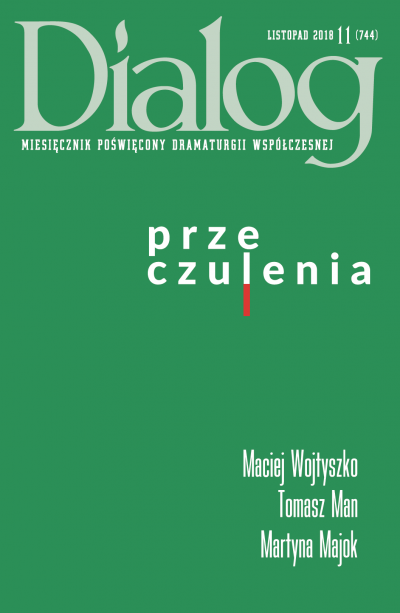
Maciej Wojtyszko
A historical comedy. It is 1917, America. Polish pianist and diplomat, Ignacy Paderewski, in vain reminds President Wilson about the situation in his country, which has not been on the map for one hundred and twenty years. The success of the mission is decided only by their wives: Edith Wilson wants to obtain a recipe for a wonderful face moisturizer from Helena Paderewska, but nothing is for free ... A play full of irony about the historical role of seemingly insignificant little things, disarming the solemn celebrations of the centenary of Poland’s regaining independence.
Mose
Tomasz Man
Inspired by the Old Testament, the story of Moses and his brother Aaron, and their great project to impose monotheism on Jews, lead them out of Egypt without blood-shed and give them independence. The play talks boldly about the backstage of power and religion. It also portrays Moses in three moments of his life as a visionary and strategist, actually a fanatic, who paid a high price for becoming a leader. The simple, contemporary language of the play emphasizes its political relevance.
Ironbound
Martyna Majok
Twenty years in the life of a Polish emigrant living in the suburbs of New York, who never experienced her American Dream. She has changed jobs and places. Her disappointment with her fate and her constant hope of arranging her life has not changed. The country she came to years ago is no less alien today than at the beginning: although she gave birth to a son here, although she met people like herself, she cannot say that she feels at home in Ironbound. The routine of waiting for a bus, for years at the same stop every day, becomes a metaphor of her experiences: each day seems to be the beginning of a new story, which, however, will always be very similar to the one she has already experienced many times.
Essays, studies
Out of the blue
Małgorzata Szpakowska
According to one option, Poland's independence was simply won. The competitive option was more about diplomacy. Still another raised the personal and artistic achievements of Ignacy Paderewski. The dispute about who deserved more was followed by the entire twenty years, and each party defended their arguments. This does not change the fact that the impression “out of the blue”, that joyful surprise which was freedom, dominated over all rationalizations.
Sheep cream
Tadeusz Nyczek
The eternal struggles of patriots and ironists in literature, theatre and cinema. The patriots cannot stand the ironists who, in their opinion, reverse and diminish history, and thereby disavow it. History is true by the fact that it is serious. It is far better to demonize history than to laugh at it. But the ironists do not listen to the patriots. They consider them old bores that continuously speak in one tone.
Slavic epics
Monika Talarczyk
It is worth discovering Paweł Pawlikowski’s earlier films. Not in the search for masterpieces that could stand the comparison with Cold War or Ida, because we will not find them there. It is fascinating to follow how the director became the author, how he found and adapted his subjects with varying degrees of success in different film genres before finding the masterful form and final fulfilment in Polish-language feature films.
Janusz Głowacki and his times
Justyna Jaworska
He was a co-author of the script of the Cold War, but he did not live to see the premiere and red carpets, he did not give interviews in Cannes, so we probably are not about to find out what exactly he has brought to the script. It is Pawel Pawlikowski, responsible (according to the credits) for “history, direction and images”, who modelled the main characters on his own parents and had a general vision of the whole, but Janusz Głowacki was in possession of an era: he had a chance to remember the Cold War in its entirety.
Neither the fox, nor the lion
Joanna Krakowska
On Wojciech Marczewski’s film Time of Betrayal of 1997, which only today one can fully appreciate, recognizing in it the most up-to-date political diagnosis, and, at the same time, the vivisection of a way of doing politics that does not count with anyone and nothing but the effectiveness of achieving goals.
The grass is greener?
Marianna Lis
In the centre of interest of Martyna Majok there are those who have not yet had their representation. So, first of all, immigrants, both those who came to the United States as adults, but also those born in the United States, still not quite American, still not at home. Apart from them, people excluded because of their disability, and their relatives and carers. Workers. Homeless. All those who are on the lower level of the social ladder, in the lowest layers of the more and more stratified American society.
American psalm
Caridad Svich
We have chosen to be in this business. Or we have been called spiritually. And some of us live in precarity and some of us do not. But I would like to turn our attention here to how a great deal of the time the fact that many theatre makers live and make in precarity (in multiple senses) is often taken for granted in this business, even though we (and I use the “we” here intentionally—dear readers in the field) are well aware that the US theatre system is as class-based as is our culture at large. (Text primarily published at: Howlround Theatre Commons)
A dialogue with the off
Adam Karol Drozdowski
It is possible that we are dealing with the best time in the post-war history of Polish independent theatre. At the same time, today's off escaped the easy, and certainly simplifying the theatrical systematics, oppositions: amateur-professional, public-non-institutional. Although it is today in all its diversity, or flickering, little by little and it is impossible to grasp it in simple definitions, one thing has not changed from the very beginning: the central category for independent theatre is the community.
The magnetes of the off get a thousand
An interview with Katarzyna Knychalska, initiator of many activities related to improving the conditions of alternative theatre in Poland, and Tomasz Rodowicz, director of the CHOREA Theater in Łódź, an artist associated with the off theatre for decades. The interviewees draw our attention to the disastrous financial situation of Polish independent theatres, resulting to a large extent from the lack of administrative and financial solutions that would be prepared with the awareness of the specificity of these theatres. The majority of theatre grants are created with the thought of institutionalized entities, so that off-theatre theatres, despite the often interesting artistic proposals, cannot compete in a fair race for a grant. As a result, alternative theatres become hostages of grants for theatrical education: it is with those funds that they often finance the premieres of their performances.
Collective. The actor’s perspective
Monika Kwaśniewska
The characteristics of the collective work model include: avoiding rigid specification of activities and hierarchy, exchange of roles, personal involvement of all members of the collective in the work process, full responsibility for the final artistic effect, and later - collective signing of the performance, and active involvement in its exploitation and development. Let us say frankly, however, that such a model of work within the Polish theatre, remaining in the "professional” trend, is very rare.
Columns
Marek Beylin, Tadeusz Bradecki, Piotr Morawski
Varia
CONTEXTS: Zofia Cielątkowska on Hannah Ryggen’s works and on fascism today. Notes on plays: Jarosław Jakubowski Człowiek z lodu; Sibylle Berg Wonderland Ave.; Dennis Kelly Girls & Boys; Playbill