


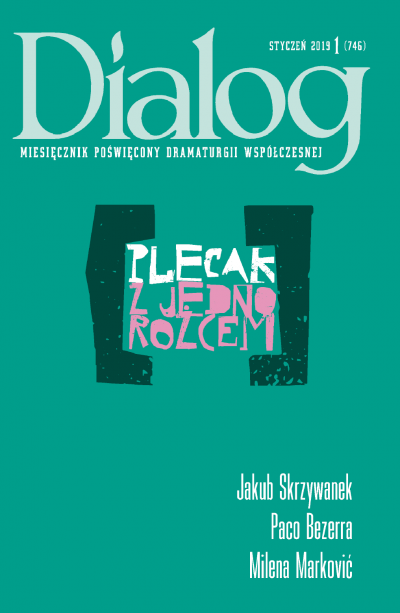
Plays
Pogrom of Pimps, Warsaw 1905. Reconstruction
Jakub Skrzywanek
A scenario of the “reconstruction” of lynching owners of Jewish brothels, which took place in Warsaw in 1905, in the wake of the revolution. This little-known event is recalled on the basis of fragments of short articles in the press, often contradictory and biased. The source materials are accompanied by comments from the author and instructions for the producer. The screenplay is open to very different projects, and at the same time it carries meta-reflection on how (and why) we should reconstruct historical events.
Children of Joy (Deca radosti)
Milena Marković
Translated by Dorota Jovanka Ćirlić
Departing from the fate of young soldiers who lost their lives during the war in the Balkans, Milena Markowić talks about lost generations implementing the fantasies of their parents. The starting point is a cemetery meeting of the Poet’s Mother and the Soldier’s Mother - both have lost their sons in the nineties and both now mourn their deaths as well as their own present lives. How much is their mourning, especially after so many years, still an expression of their own need, and to what extent is it just blending in with societal expectations? Marković speaks of the mythologizing of national fates, in which similar victims alongside with a similar need to glorify them recur.
Little Pony (Mi pequeño poni)
Paco Bezerra
Translated by Maciej Krysz and Michał Kurkowski
A nine-year-old pupil becomes a victim of school violence because he comes to school carrying a backpack with a colourful unicorn – an imprint typical of girls’ rather than boys’ schoolbags. The school authorities wash their hands of this, as if the nine-year-old himself and his bag were guilty of the situation. Paco Bezerra centres his play around the dialogues of the parents trying to solve their son's problem, whether it is persuading him to change the bag, or, on the contrary, to remain faithful to his own values.
Essays, Studies
Artists’ Testimonies: Theatre of the Real
Carol Martin
The difference between waking and sleeping, between being live and being recorded, between being present and being a projection of presence, is collapsing. The entanglement of the live and the digital in relation to the documents presented onstage demands an audience willing to collaborate in the construction of meaning as a vital part of the production. Site-specific performances, mixes of biography, autobiography, and documentary, fiction and nonfiction, film, visual arts, dance, theatre, and performance art are merging. As the digital world becomes the means of documentation, documentaries become much more than records.
A few remarks on the pimps pogrom
Michał Narożniak
So far, the analysis of Warsaw events of 1905 known as the “pogrom of pimps” has only been performed in a narrow circle of historians. Theatre has a much better chance to fire imagination, and it can have closer contact with these dramatic events, and thus encourage reflection. As a result, history will cease to be a post-mortem examination, and it will become a tool for exploring our own emotions.
“A symptom of moral heath”
Anna Kuligowska-Korzeniewska
Even the fact that in the spring of 1905 none of the owners of restaurants and gardens usually visited by workers would apply for permission to organize traditional folk games in the open air is good enough to convey the workers' moods. The revolution also awakened in the workers the desire to raise the level of education, morality and the sense of personal dignity among their sphere.
Raise your horns!
A conversation of Łukasz Jaskuła and Kornelia Sobczak about unicorns - a queer, subversive symbol, which has been captured by capitalism. About infantilization as a conscious strategy of the generation of "junkcontracts", and about the differences between homo propaganda and the patriarchal hetero propaganda.
Capitalism in theatre
A conversation with Michał Kotański, director of the Żeromski Theatre in Kielce in the Weather Forecastcycle about the situation of Polish theatre in the context of the social situation and the cultural policy of the state.
Ferment
Jakub Papuczys, Katarzyna Waligóra
For the last six years of his management at the Żeromski Theatre in Kielce Piotr Szczerski had been developing a model of such repertoire construction, so that both ambitious and mainstream propositions appear in it. The model of mixing performances of various gravity in repertoire has been continued by Michał Kotański. The last season has earned the Kielce theatre recognition not only on the part of the audience, but also on the part of the critics. All three performances (Rasputin, 1946, Darkness) that entered the Competition for the Staging of a Polish Contemporary Play got to the finals. The current season will be a good test, whether the developed artistic level and a more mature way of communication with the audience can be maintained with more modest stagings and more popular repertoire.
Manifest and hidden. Two versions of Polish history on the example of debates about the elites in the Kielce pogrom
Joanna Tokarska-Bakir
The starting point here are two reviews referring to Joanna Tokarska-Bakir’s book Pod klątwą. Społeczny portret pogromu kieleckiego [Under the Curse. A Social Portrait of the Kielce Pogrom]. The first is the "Poison gas factory" by Małgorzata Szpakowska (Dialog No. 5/2018). The second is entitled Resumé of the pogrom of thepen by Marcin Zaremba in the journal Zagłada Żydów. Studia i Materiały No. 14 of 2018. The book has earned recognition from both reviewers. Both, however, share skepticism about the author's thesis that the Kielce pogrom was not the work of mobs, but of the whole society.
Pressions of false freedoms
Gabriela Abrasowicz
The work of Milena Marković, a Serbian playwright, poet, screenwriter and lecturer at the Belgrade Department of Dramatic Arts, has been functioning as a separate, unique phenomenon on local stage. Attempts to reduce her work to one distinguishing feature are quite breakneck, and have sometimes been openly criticized by her. The author emphatically expresses her unwillingness to label her artistic propositions or to pigeonhole her, which is why she is still deciding on new solutions. This is due to both the need for creativity and change, as well as some kind of defiance.
Columns
Marek Beylin, Tadeusz Nyczek, Piotr Morawski, Tadeusz Bradecki
Varia
Contexts: Ida Ślęzak on ecology in theatre on the margin of Julie Sermon’s "Les imaginaires écologiques de la scène actuelle. Récits, formes, affects" in: Théâtre/Public no. 229, 2018.
Notes on Plays: Jarosław Mikołajewski Komórka; Wajdi Mouawad Tous des oiseaux; Clemens J. Setz Die Abweichungen.
Playbill