


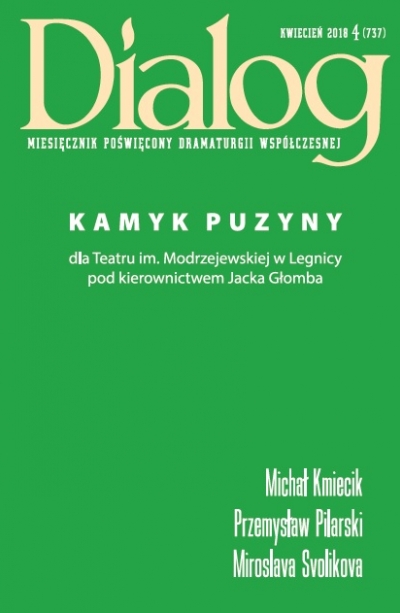
Contents:
Plays
Michał Kmiecik
Rutka’s Memory
A play based on the memoirs of a fourteen-year-old Rutka Laskier, which she kept in the Będzin ghetto in the last months before her deportation to Auschwitz. The author does not adapt the records of the girl faithfully, he rather tries to translate her experiences into the rebellion and emotions of today's teenagers. The text is addressed to "young adults" and it contains contemporary references to pop culture, politics or new media. Rutka's anger turns against today's situation in Poland, becoming gradually a universal manifesto of resistance.
Przemysław Pilarski
Come Back
A strange, oneiric tale of returning to your hometown. After years a traveling musician in the style of Bob Dylan appears in his own home, but he discovers other people who live there, and no one explains anything to him. A story based on the fate of Holocaust survivors from Radom, after the war persecuted by Poles who had occupied their flats. Vague hints and symbols create an atmosphere of mystery like in the "Twin Peaks" series : facts are not explicitly mentioned here. The tension is relieved by the perverse, anarchist finale.
Miroslava Svolikova
die hockenden
A story about a banal visit to a bar spread into four choirs - once told by those who are watching, sometimes those (or the one) coming in, and at times those who do not care what is happening in front of their eyes. Who are the characters of Svolikova’s drama? Immobilized, doomed to ponder upon the smallest shreds of events happening before them, they seem to sing a kind of musical ballad about the time that has stopped and about the impossibility of change. Are they afraid they really cannot change anything in their lives, their fate imprisoning them here and not elsewhere?
Essays, Studies
Konstanty Puzyna Kamyk Award of 2018 for the Helena Modrzejewska Theatre in Legnica managed by Jacek Głomb.
Jolanta Kowalska
Legnica idiom
Conversations with actors of the Helena Modrzejewska Theatre in Legnica:
Anita Poddębiak, Bogdan Grzeszczak, Joanna Gonschorek, Katarzyna Dworak, Paweł Wolak, Magda Drab, Rafał Cieluch, Robert Gulaczyk.
Piotr Olkusz
Legnica writing
Does the Legnica school of playwrights exist, there certainly being the Legnica acting? On dramas written in Legnica in 1997-2013, forming a two-volume drama anthology.
Common interest in the world.
A conversation with Jacek Głomb, director of the Helena Modrzejewska theatre in Legnica.
Conversation in the Weather Forecast cycle about the situation of Polish theatre in the context of the social situation and the cultural policy of the state.
Piotr Morawski
Breaching of the consensus
From the planned premiere of Oliver Frljic's Non-Divine Comedy at the Stary Theatre in Kraków to Michał Zadara's Justice at the Powszechny Theatre in Warsaw. What can the theatre do and what it cannot do about anti-Semitism?
Paulina Skorupska
Maja Kleczewska’s Rehearsal Room
The Jewish theater, co-producing the Painted Bird with the Polish Theatre in Poznań, and collaborating with TR Warszawa at Golem, moves its Rehearsal Room known from the Dybbuk performance into other places. It is an installation that is a trace, a reconstruction strengthening the absence of the real one by its actual presence. Used in three performances, it becomes a relic itself, a visible sign of the non-existent.
Stanisław Godlewski
Landscape after the battle
The author analyzes contemporary conservative and rightist theatre criticism in terms of the figures and imagery it uses. The author focuses primarily on war and phonic metaphors, pointing to the logical errors and the ideological consequences of conservative criticism.
Columns
Marek Beylin, Tadeusz Nyczek, Tadeusz Bradecki
Varia
Contexts
Notes on plays:
Sascha Hargesheimer Polen ist mein Italien; Ewald Palmetshofer Vor Sonnenaufgang